Listen to this Article
If your child has ADHD, you may know this morning pattern too well: you ask them to brush their teeth, get dressed, pack their bag, and come to breakfast. Ten minutes later, they are sitting on the floor, half-dressed, playing with something they found on the way.
It may look like they are ignoring you. Often, they are not. Many children with ADHD struggle with working memory, task initiation, time awareness, transitions, and follow-through. A visual schedule for ADHD can help because it moves the routine out of your voice and into something your child can see.
The short answer: yes, visual schedules can help children with ADHD, but they usually do not work exactly the same way as visual schedules for autism. ADHD visual schedules often need to be shorter, more interactive, more motivating, and easier to restart when attention drops.
What is a Visual Schedule for ADHD?
A visual schedule for ADHD is a picture-based or step-by-step routine that shows a child what to do now, what comes next, and when the routine is finished.
It can be:
- A printed morning routine chart
- A first-then board
- A checklist with pictures
- A visual timer plus task cards
- A routine app with visual prompts and rewards
For a child with ADHD, the schedule works like an external memory system. Instead of holding every instruction in their head, the child can look at the visual cue and return to the next step.
Example: Wake up → Brush teeth → Get dressed → Eat breakfast → Pack bag
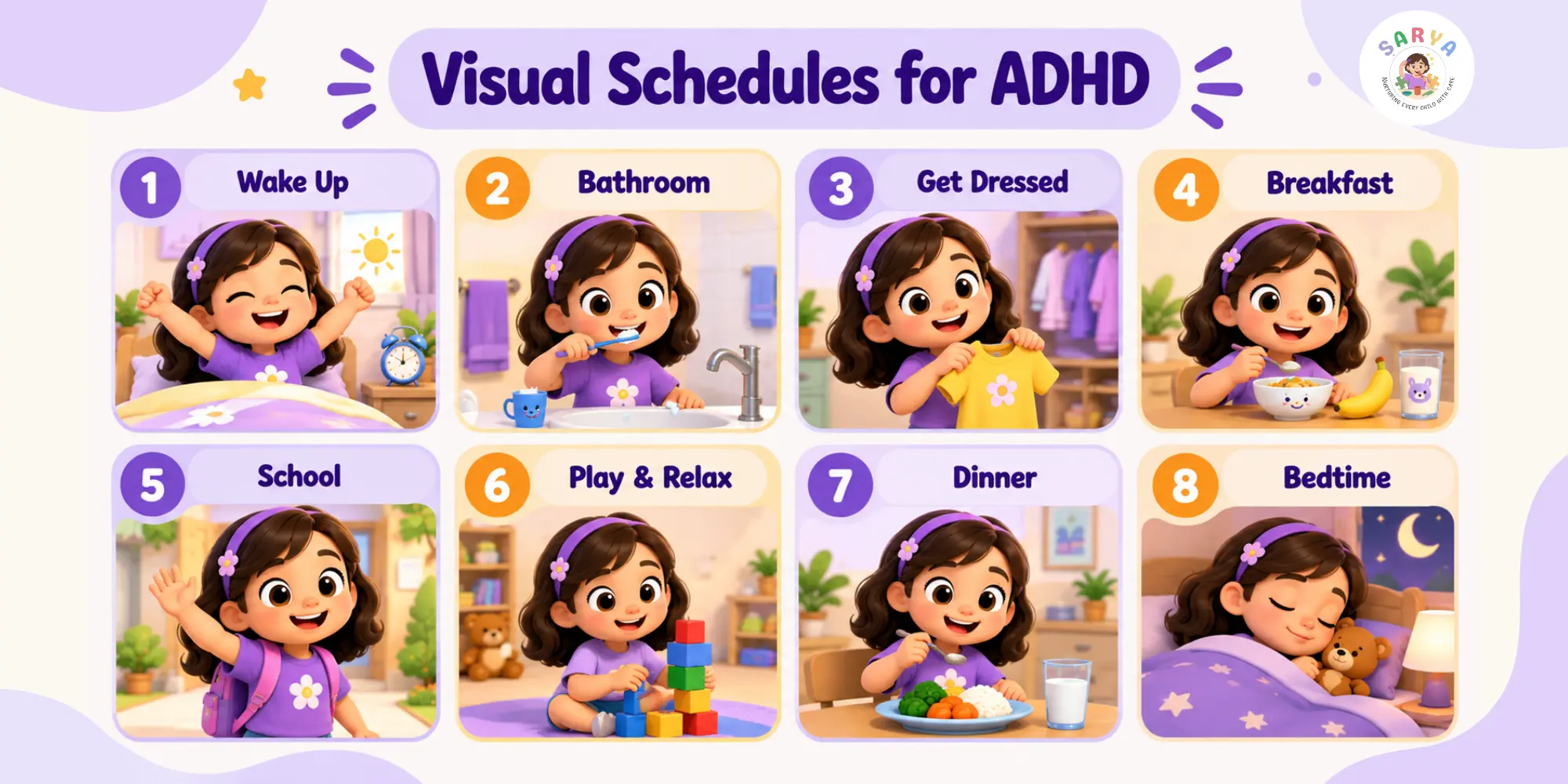
That simple sequence can reduce the need for repeated verbal reminders. It also gives the child a visible path through the routine.
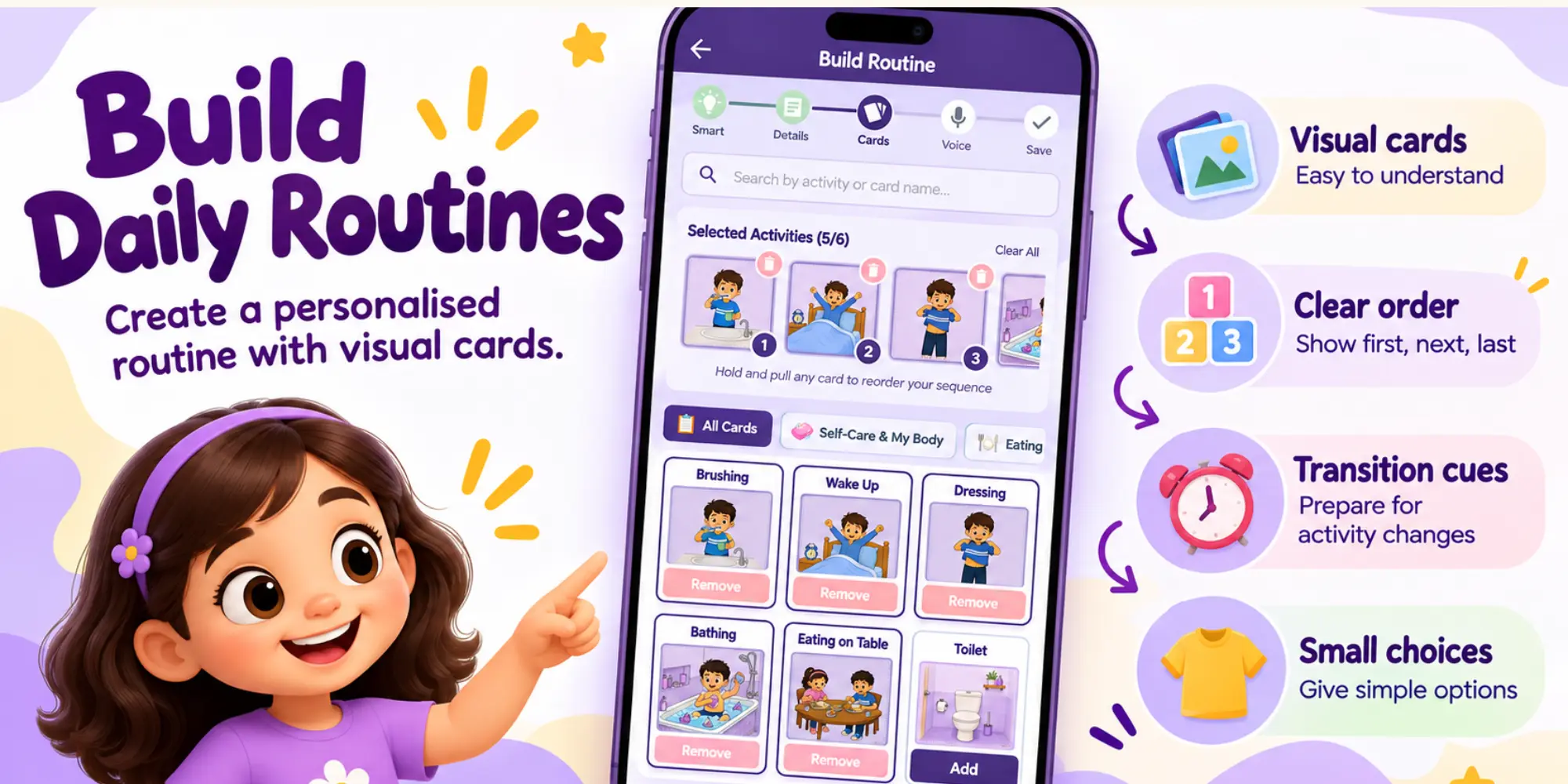
If you want a digital version, Sarya’s ADHD routine app uses visual cards, voice prompts, and star rewards to help children move through daily routines with less parent prompting.
Do Visual Schedules Work for ADHD?
Yes, visual schedules can help many children with ADHD, especially when they are used as part of a consistent routine and parent-supported behaviour plan.
They are not a cure for ADHD. They do not replace assessment, parent training, therapy, classroom support, or medication when those are needed. But they can be a practical home tool for everyday routines.
CDC notes that behaviour therapy can improve behaviour, self-control, and self-esteem in children with ADHD, and that parent training helps families use strategies that support the child at home, school, and in relationships.
Visual schedules fit into that same practical support system because they help with:
- Remembering steps
- Starting tasks
- Reducing repeated instructions
- Moving between activities
- Making routines predictable
- Building independence gradually
CDC’s 2024 data reports that about **7 million** U.S. children aged 3-17 years, or 11.7%, have a current ADHD diagnosis. That makes ADHD support at home and school a major everyday need for families.
ADHD vs Autism: Do Visual Schedules Work the Same Way?
Visual schedules can help both autistic children and children with ADHD, but the main reason they help is often different.
For many autistic children, a visual schedule reduces uncertainty. It helps the child know what is happening now, what comes next, and when a change is coming. For ADHD, the bigger challenge is often task initiation, attention, working memory, and motivation.
That is why the same chart may calm one child but bore another.
| Design Choice | ADHD Visual Schedule | Autism Visual Schedule |
|---|---|---|
| Main purpose | Helps the child start, remember, and finish | Builds predictability and reduces uncertainty |
| Best length | Short, often 3-5 steps | Can include a fuller routine if the child benefits |
| Motivation | Checkmarks, stars, rewards, visible progress | Predictability itself may be calming |
| Layout | Flexible, movable, interactive | Often more consistent and fixed |
| Best use | Morning routine, homework, screen-off, bedtime | Daily routine, transitions, school schedule, therapy routine |
If your child has both ADHD and autism, start with predictability first, then add ADHD-friendly features like checkmarks, rewards, and voice prompts.
For a deeper autism-specific guide, read Sarya’s existing blog on visual schedules for autism.
Why ADHD Children Struggle With Routines
Many parents ask, “My child knows the routine, so why don’t they just do it?” With ADHD, knowing the routine is not always the same as being able to start and complete it.
Working Memory: “I Forgot What Comes Next”
Working memory helps a child hold instructions in mind while doing the task. A child with ADHD may remember the first step, then lose the rest.
A visual schedule reduces this load. The child does not have to remember all the steps. They can look back at the schedule whenever they drift.
Task Initiation: “I Know, But I Can’t Start”
Some ADHD children understand the instruction but still struggle to begin. This is task initiation difficulty, not laziness.
A visual routine helps by making the first step obvious and small. Instead of “get ready for school,” the first card says “brush teeth.” That feels more doable.
Time Blindness: “I Didn’t Know It Took That Long”
Many children with ADHD struggle to feel time passing. “Five minutes” may not mean much unless they can see it.
Pairing a visual schedule with a timer can help. The schedule shows what to do. The timer shows how long the child has.
Transitions: “Stopping Is Hard”
Going from play to homework, screen time to dinner, or bed to school can be difficult. A visual schedule makes the transition less sudden.
A child can see:
- First: finish game
- Then: pack bag
- Next: dinner
That visible sequence reduces negotiation and repeated reminders.
How to Build a Visual Schedule for ADHD
The biggest mistake parents make is building a perfect-looking chart that is too long for the child to actually use. ADHD routines work better when they are simple, visible, and rewarding.
1. Start With One Routine
Do not try to fix the whole day at once. Choose the routine that causes the most stress.
Good first routines include:
- Morning routine
- Bedtime routine
- Homework start
- Getting ready for school
- Screen-off transition
- Brushing teeth
- Packing the school bag
Start small. Once one routine becomes easier, build the next.
2. Keep It to 3-5 Steps
For many children with ADHD, a 10-step routine chart becomes visual noise. A shorter routine is easier to scan and easier to finish.
Example morning routine: Brush teeth → Get dressed → Eat breakfast → Pack bag → Shoes on
If even that feels hard, start with three steps: Brush teeth → Get dressed → Breakfast
Add more only after the child can follow the first version with less prompting.
3. Use Pictures Your Child Recognizes
Generic icons can work, but real-life pictures often work better. A photo of your child’s actual toothbrush, school bag, uniform, lunchbox, or prayer mat may be easier to understand than a random clipart image.
This is where Sarya’s visual schedule app is useful for global families. Sarya is built around culturally relevant visual cards, routines, and ADL skills, so children can follow images that feel closer to their real life.
4. Add a Clear Finish Point
ADHD brains often respond better when the finish line is visible. The child should know when the routine is complete and what happens after.
Example: Brush teeth → Get dressed → Pack bag → Stars earned → Breakfast
The reward does not need to be big. It can be:
- A star
- A checkmark
- A high-five
- A two-minute preferred activity
- Choosing a song
- Moving a card to “done”
The goal is not bribery. The goal is visible progress.
5. Use One Calm Prompt
Instead of repeating the full instruction again and again, use one short prompt:
“Check your schedule.”
Then point to the next card.
This helps the child learn to use the visual cue instead of depending only on the parent’s voice.
6. Review the Schedule Before the Routine Starts
Do not introduce the chart in the middle of a meltdown or when you are already late.
Review it calmly:
“This is your morning routine. First brush teeth, then get dressed, then breakfast. When all three are done, you earn a star.”
Repetition builds trust.
Best ADHD Routines to Start With
Different families struggle at different times of day, but these routines are usually the best starting points.
Morning Routine Visual Schedule
Morning is often the hardest because the child is sleepy, parents are rushed, and school has a fixed start time.
Use cards like:
- Wake up
- Bathroom
- Brush teeth
- Get dressed
- Eat breakfast
- Pack bag
- Shoes on
Keep the chart near the place where the routine starts, not hidden in a drawer.
Bedtime Routine Visual Schedule
Bedtime works well because it is repetitive and predictable.
Use cards like:
- Pajamas
- Brush teeth
- Toilet
- Story
- Lights off
If your child resists sleep, keep the bedtime chart calm. Avoid too many reward elements at night.
Homework Routine Visual Schedule
For ADHD, “do homework” is too big. Break it into smaller steps.
Example: Sit at table → Open bag → Take out book → Do first question → Take short break
A visual timer can help here because homework often fails at the starting point, not only the task itself.
Screen-Off Transition Schedule
Screen transitions can be intense. Try: Timer → Save game → Turn off screen → Snack → Next activity
The schedule should show what comes after the screen, not only that the screen is ending.
Printable Chart vs Visual Schedule App: Which Is Better for ADHD?
Both can work. The better choice depends on your child and your home routine.
A printable ADHD routine chart may be better if:
- Your child likes physical cards
- You want less screen use
- The routine is simple
- You can keep the chart visible in one place
A visual schedule app may be better if:
- Your child needs voice prompts
- The routine changes between home, school, and therapy
- You want rewards built in
- You need progress tracking
- You want culturally familiar visual cards
- Your child responds well to tapping, stars, and interactive steps
Sarya’s ADHD app is designed for children who need visual routine support, audio prompts, micro-task breakdowns, and motivating star rewards. Sarya also lets families build routines for morning, evening, bedtime, and daily living skills.
Where Sarya Fits Into an ADHD Routine
Sarya is not a medical treatment for ADHD. It is a practical visual routine and ADL skills tool that can support the daily structure children need.
Parents can use Sarya to:
- Build a morning routine
- Create a bedtime routine
- Break big tasks into smaller steps
- Add voice prompts
- Use star rewards
- Track routine completion
- Support brushing, dressing, hygiene, and other ADL skills
- Use visual cards that feel familiar to the child
That matters because many children do not fail routines because they “do not care.” They fail because the routine is too verbal, too long, too abstract, or too dependent on adult reminders.
Sarya helps make the next step visible.
Try it here: Sarya Visual Schedule App
When a Visual Schedule Is Not Enough
A visual schedule is a helpful tool, but some children need more support than a chart or app can provide.
Consider professional guidance if your child has:
- Severe aggression or self-injury
- Major sleep problems
- Extreme school refusal
- Frequent meltdowns
- Developmental regression
- Very delayed speech or communication
- Sensory issues affecting daily life
- Difficulty functioning at home and school
- ADHD symptoms causing significant impairment
The American Academy of Pediatrics says ADHD care may include behavioural therapy, parent training, school supports, and when appropriate, medication. Educational interventions and individualized supports are also important parts of treatment planning. (AAP Clinical Practice Guideline)
For child development support in India, parents can explore Aaryavart Centre’s therapy process, occupational therapy for children, and behaviour therapy and parent training. These can be useful when routine struggles are connected with sensory needs, behaviour challenges, autism, ADHD-like concerns, or developmental delays.
Final Takeaway
A visual schedule for ADHD can work very well, but it needs to be designed for the ADHD brain.
For ADHD, keep it:
- Short
- Visual
- Reward-linked
- Easy to restart
- Paired with a timer or voice prompt
- Focused on one routine at a time
For autism, visual schedules often focus more on predictability and reducing uncertainty. For ADHD, they should focus more on starting, remembering, transitioning, and finishing.
If you are tired of repeating the same instruction every morning, start with one routine and three visual steps. Keep it consistent for a week. If you want an easier digital setup, try Sarya free and build your child’s first visual routine in minutes.
Visual Schedules for ADHD FAQs
Do visual schedules help children with ADHD?
Yes. Visual schedules can help children with ADHD by making routines visible and reducing the need to hold every step in working memory. They are most useful for morning routines, bedtime, homework, transitions, and daily living skills.
How many steps should an ADHD visual schedule have?
Start with 3-5 steps. Too many steps can overwhelm a child with ADHD. Add more only when the shorter routine becomes easier.
Are visual schedules for ADHD different from autism visual schedules?
Yes. Autism visual schedules often focus on predictability and reducing uncertainty. ADHD visual schedules usually need to support task initiation, working memory, time awareness, motivation, and visible progress.
What is the best first routine to build for a child with ADHD?
Start with the routine that causes the most daily stress. For many families, that is the morning routine, bedtime routine, homework start, or screen-off transition.
Should I use rewards with an ADHD routine chart?
Small rewards can help. Use stars, checkmarks, a “done” section, or a short preferred activity. The reward should support motivation without becoming the only reason the child follows the routine.
Is a visual schedule app better than a printable chart?
Not always. Printable charts are simple and screen-free. A visual schedule app may be better if your child needs voice prompts, star rewards, progress tracking, custom visuals, or routines that travel between caregivers and settings.
Can visual schedules replace ADHD treatment?
No. A visual schedule is a support tool, not a replacement for diagnosis, parent training, therapy, school support, or medication when needed. If ADHD symptoms are affecting daily functioning, speak with a qualified healthcare professional.
Can Sarya help children with both autism and ADHD?
Yes. Sarya can support children with autism, ADHD, Down syndrome, and other neurodevelopmental needs by using visual routines, voice prompts, rewards, and ADL skill-building. For children with both autism and ADHD, keep routines predictable while adding ADHD-friendly motivation and progress cues.
Archana Pandey
Sarya Team Member