Listen to this Article
Every morning, Priya's mother faced the same battle: a 6-year-old overwhelmed by the string of steps between "wake up" and "out the door." Priya has autism, and spoken instructions — "get dressed, brush your teeth, pack your bag" — dissolved before she could act on them. That's a scene playing out in homes everywhere, and it has a well-documented fix. A visual schedule for autism — a sequence of pictures or icons that shows a child what's happening now and what comes next — is one of the most researched, most recommended tools in autism support. Done right, it doesn't just get kids out the door faster. It rebuilds trust, cuts anxiety, and hands a child back a sense of control over their day. Here's what a visual schedule is, why it works, and how to build one your child will actually use.
What is a Visual Schedule for Autism?
A visual schedule for autism is a series of pictures, icons, or photos arranged in order to show a child what activity is happening now and what comes next — replacing spoken instructions with something they can see and revisit. It can be as simple as two cards ("first," "then") or as detailed as a full-day picture timetable covering meals, school, therapy, and bedtime.
Visual schedules are sometimes called picture schedules, visual timetables, or routine charts, and they show up in three main formats: paper charts and cards, a physical board with movable pieces, or an app that guides a child through each step. Whatever the format, the job is the same — turn an unpredictable day into something a child can see coming.
Why Visual Schedules Work for Autistic Children (the Evidence)
Visual routines work particularly well for children with autism for four connected reasons — and once you see the pattern, it explains why autism therapists, occupational therapists, ABA practitioners, and special educators reach for them before almost any other tool.
Predictability Reduces Anxiety
Uncertainty is one of the biggest anxiety triggers for autistic children — not knowing what happens next, or when a preferred activity will end, keeps the nervous system on alert. A visual schedule answers the questions a child can't always ask out loud: What's happening now? What comes next? When does this end? That predictability is what calms a child enough to engage with the activity in front of them, instead of the uncertainty around it.
Visual Cues Don't Disappear Like Spoken Words
A spoken instruction — "get dressed, then eat breakfast, then get your bag" — is gone the second it's said, and it asks a child to hold three steps in working memory while managing everything else about their morning. A picture stays put. It waits until a child is ready to look, and it can be checked again and again without a parent repeating themselves or a child feeling like they've failed to listen.
They Build Real Independence
Every time a parent walks a child through a task by hand, the lesson learned is "I need someone else to do this." A visual schedule shifts that: the child learns to check the schedule, complete the step, and move to the next one, largely on their own. That's the same independence Sarya's ADL skills tools are built around — not doing things for a child, but giving them a support that lets them do it themselves.
Backed by Special Education and ABA Practice
Visual schedules aren't a trend — they're a core, evidence-based component of TEACCH structured teaching and Applied Behavior Analysis, used in special education classrooms and therapy rooms for decades. For a deeper look at the research behind why visual approaches help many autistic and ADHD learners, see our full breakdown of the science behind visual learning.
Real Families, Real Results: Priya's Story
The breakthrough for Priya's family came when her mother discovered visual routines through Sarya's Daily Wonder Book app. By creating a step-by-step visual schedule with familiar contexts — wearing a kurta, using the bathroom fixtures Priya recognized from home, packing her actual lunch box — Priya began to understand and follow her morning routine independently.
The change wasn't instant, and it didn't need to be. Her mother started with just three steps: wake up, brush teeth, get dressed — and let Priya master that sequence before adding "pack school bag, put on shoes, say goodbye to family."
Within three months, Priya's morning routine went from 45 minutes of constant prompting to 15 minutes with minimal assistance. "It's like she finally understands what's expected of her," her mother says. "The visual cues give her confidence and reduce her anxiety."
Priya's story is common among children with special needs: when the learning context matches a child's actual daily environment — the clothes they wear, the objects they recognize — they generalize the skill faster and build independence sooner. It's also the exact insight most generic visual schedule tools miss: a stock photo of a Western-style toilet or breakfast table doesn't mean much to a child whose daily life looks different.
How to Make a Visual Schedule for Autism: A Step-by-Step Guide
Building your first visual schedule doesn't require special training or expensive materials — it requires starting small and staying consistent. Here's the process that worked for Priya, and that we recommend to every family starting out.
1. Start with 3-4 Steps, Not the Whole Day
Resist the urge to map out sunrise to sunset on day one. Pick the routine causing the most stress — usually mornings or bedtime — and break it into three or four steps. Add complexity only once your child is confidently following what's already there.
2. Choose a Format That Matches Your Child
Some children do best with a physical board and cards they can move by hand. Others respond better to a digital schedule that adds a voice prompt or a short animation as a reward for finishing a step — useful for kids who need an extra nudge to stay engaged, or families who want one schedule that travels between home, school, and therapy without printing anything new.
3. Use Images Your Child Actually Recognizes
This is the step most printable templates skip. A picture only works as a cue if a child recognizes what's in it. If your routine involves a kurta instead of a t-shirt, a bucket bath instead of a shower, or a lunch dabba instead of a lunchbox, use images of those — not generic clip art. It's a small change that makes a measurable difference in how quickly a child connects the picture to the action.
4. Pair Every Picture with the Same Word, Every Time
Consistency is what turns a picture into a cue. Use the same label — spoken and, where possible, written — every time a step appears, across every setting. This also helps emerging readers start connecting the word to the picture.
5. Review, Celebrate, and Add Steps Gradually
Walk through the schedule with your child before starting, celebrate each completed step, and only add new steps once the current routine feels automatic. Progress isn't linear, and that's fine — the goal is a schedule your child trusts, not one that's technically complete.
Types of Visual Schedules for Different Routines
Here are the primary types of visual schedules for different routines that your child can follow:
Morning Routine Visual Schedule
Wake up, brush teeth, get dressed, eat breakfast, pack bag, shoes on. A morning schedule gives kids a clear, repeatable start to the day and cuts down the stalling that comes from not knowing what's next.
First-Then Boards for Quick Wins
A simplified, two-step version: "first [task], then [preferred activity]." First-then boards are a staple in ABA therapy because they're fast to set up and effective for building cooperation on one difficult task, without a full-day schedule.
Bedtime and After-School Routines
Arrive home, snack, homework or quiet time, dinner, bath, story, lights out. The transition from school to home is often one of the hardest of the day for autistic children — a visual schedule bridges that gap the same way it does in the morning.
Classroom and Therapy Schedules
Circle time, centers, snack, outside play, story time, pack up. Teachers and therapists use the same principle to structure a session or school day, often with individualized schedules for children who need more support than the group schedule provides.
Printable Chart vs. Visual Schedule App: Which Should You Use?
Both formats work, and the right choice depends on your family. A printable chart or card set is low-cost, doesn't need a screen, and is easy to stick on a fridge or classroom wall — a good starting point, especially for a first schedule.
- Voice-guided prompts so a child doesn't need an adult to narrate each step.
- Built-in rewards that keep a child engaged without you managing a sticker chart.
- One schedule that syncs across home, school, and a caregiver's phone, instead of three printouts.
- Images you can actually swap for what your family recognizes, instead of the generic Western icons most printable libraries default to.
That last point matters more than it sounds. A picture is only useful if a child connects it to their own life, and most free printable libraries are built around one cultural default. That gap is exactly why we built Sarya.
Why Sarya's Visual Schedule App Was Built for Families Worldwide
Sarya is a free visual schedule and ADL skills app built specifically around the problem above: most visual supports assume every family's mornings look the same. Ours doesn't.
With Sarya's Daily Wonder Book, you can build a visual schedule using contexts your child actually recognizes — the clothes, food, and routines of home — paired with gentle voice guidance in multiple languages, so a child can follow their schedule without waiting for an adult to walk them through it.
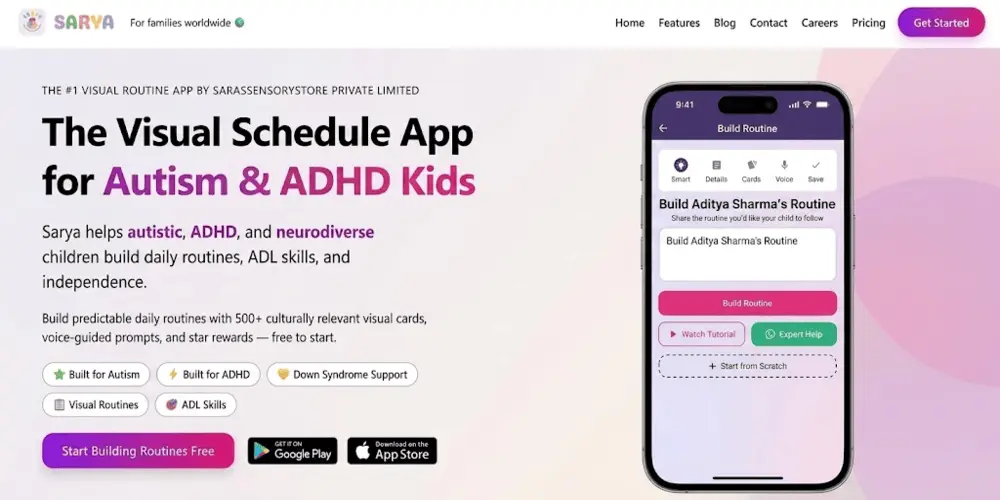
Beyond the schedule itself, Sarya includes ADL (Activities of Daily Living) skill-building for tasks like brushing teeth, getting dressed, and toilet training, using the same culturally familiar, step-by-step approach — so the same tool that gets your child through the morning also helps them build the self-care skills behind it.
It's free to start, built by a child psychologist and a parent-led team, and designed for families supporting autistic, ADHD, and Down syndrome children anywhere in the world — not just the households a template happened to be designed for.
Get Sarya free: [Google Play](https://play.google.com/store/apps/details?id=com.thesarya.digitalbook) | [App Store](https://apps.apple.com/us/app/sarya-daily-wonder-book/id6752542833)
Common Mistakes to Avoid When Introducing a Visual Schedule
- Starting with too many steps. A 10-step full-day schedule on day one overwhelms a child before the tool builds trust. Start with three or four.
- Changing images or labels frequently. Consistency is what makes a picture a reliable cue.
- Skipping the "why." Walk your child through the schedule before you need them to use it, not mid-transition.
- Using pictures your child doesn't recognize. Unfamiliar icons ask a child to do extra translation work a familiar image wouldn't require.
- Removing the schedule once things improve. Many autistic children rely on visual structure long-term — fade the prompting, not the tool.
- Expecting instant results. Priya's family saw real change at three months, not three days.
Start Your Child's First Visual Schedule Today
A visual schedule for autism won't fix every hard morning, but for most families, it's the single change that turns constant prompting into a routine a child can actually own. Start small, stay consistent with the images and words you use, and give it more than a few days to click.
If you'd rather skip building one from scratch, Sarya's free app comes with visual schedules and ADL skill-building already built in, in contexts your child will actually recognize.
Visual Schedule for Autism FAQs
What is a visual schedule for autism?
A visual schedule for autism is a sequence of pictures, icons, or photos that shows a child what's happening now and what comes next, replacing spoken instructions with a visual cue they can see and revisit independently. It's used at home, in classrooms, and in therapy to reduce anxiety and build independence.
At what age should I start using a visual schedule?
Visual schedules can be introduced as early as age 2-3 using simple picture cards, and preschool-aged children (3-5) tend to respond especially well to a full routine chart. Older children, teens, and even adults with autism continue to benefit from visual schedules adapted to their level.
How do I make a visual schedule for autism at home?
Start with the routine causing the most stress, usually mornings or bedtime, break it into three or four steps, use images your child actually recognizes, and pair each picture with a consistent word. Add more steps only once the current routine feels automatic.
What's the difference between a visual schedule and a first-then board?
A first-then board is a simplified, two-step visual schedule: "first" shows the current task, "then" shows what follows, often used in ABA therapy to build cooperation on a single task. A full visual schedule extends the same idea across an entire routine or day.
Do visual schedules help with ADHD too?
Yes. Children with ADHD often struggle with executive function and holding multi-step instructions in working memory. A visual schedule externalizes the plan, so the child isn't relying on memory alone to know what's next.
Are visual schedules evidence-based?
Yes. Visual schedules are a well-documented, evidence-based practice in special education and are a core part of structured teaching approaches like TEACCH, alongside decades of use in Applied Behavior Analysis.
How is Sarya's app different from a printable visual schedule?
Sarya adds voice-guided prompts, culturally familiar images your family will actually recognize, and ADL skill-building in one free app, instead of a static printout — a schedule that talks a child through each step and grows with them.
Archana Pandey
Sarya Team Member