Listen to this Article
If your child does not speak yet, speaks only a few words, pulls your hand to show what they want, or gets upset because you cannot understand them, you are not alone. Many parents first hear the word PECS during a speech therapy, autism therapy, or AAC discussion.
PECS, or the Picture Exchange Communication System, is a structured way to help a child communicate using pictures. It is often used with autistic children, non-verbal children, and minimally verbal children who need a reliable way to request, choose, answer, or share something before speech is fully functional.
It is important to say this clearly: PECS is not the same as a picture schedule. A picture schedule helps a child understand routines. PECS helps a child communicate with another person.
What Is PECS?
PECS stands for Picture Exchange Communication System. It is a structured augmentative and alternative communication, or AAC, method where a child learns to give a picture to a communication partner to express a message.
The official PECS source, Pyramid Educational Consultants, says PECS was developed in the USA in 1985 by Andy Bondy, PhD, and Lori Frost, MS, CCC-SLP. It begins by teaching a learner to give a single picture of a desired item or action to another person, who immediately honors that exchange as communication.
What PECS Means in Simple Parent Language
In everyday parent language, PECS means your child uses a picture to say something they cannot yet say with speech.
For example:
- Your child gives you a picture of juice to request juice.
- Your child gives a picture of a ball to ask for the ball.
- Later, your child may use a strip that says “I want” plus a picture.
- With training, the system may expand to answering questions and commenting.
The point is not just showing a picture. The key is the exchange. The child gives the picture to another person to send a message.
Is PECS Only for Autism?
PECS is widely used with autistic children, but it is not only for autism. It may also support children with limited speech, developmental delays, speech-motor difficulties, or other communication needs when guided by a qualified professional.
ASHA explains that AAC can support people with speech, language, reading, or writing limitations, including neurological differences such as autism. AAC may include gestures, objects, pictures, communication boards, and speech-generating devices.
Who Can Benefit From PECS?
PECS is usually considered when a child has a gap between what they want to communicate and what they can express. That gap can become frustrating for the child and exhausting for parents.
A child may benefit from PECS or another AAC system if they need a more reliable way to communicate across home, school, and therapy.
PECS May Help Non-Verbal or Minimally Verbal Children
PECS may be useful for children who:
- Do not speak yet
- Use only a few words
- Pull adults by the hand instead of asking
- Cry or get upset when not understood
- Can choose between preferred items
- Need help making requests
- Have autism-related communication challenges
- Have speech delay or limited functional communication
Aaryavart’s PECS Communication page describes PECS as support for non-verbal and minimally verbal children to ask, choose, and be understood. It also explains that PECS can become a bridge to spoken language for some children, not a replacement for speech.
PECS May Help When Speech Therapy Alone Is Not Enough Yet
Some children attend speech therapy but still cannot reliably express daily needs. In that case, PECS or another AAC method may give the child a communication route while speech and language skills continue developing.
Aaryavart specifically notes that PECS should be used alongside Speech Therapy, not as a stand-in for it. This is the right parent mindset: communication support now, speech-language development alongside it.
How PECS Works: The 6 Phases Explained Simply
PECS is not just handing a child random picture cards. It follows a structured teaching protocol. Pyramid describes six PECS phases, beginning with a single-picture exchange and moving toward discrimination, sentence structure, answering questions, and commenting.
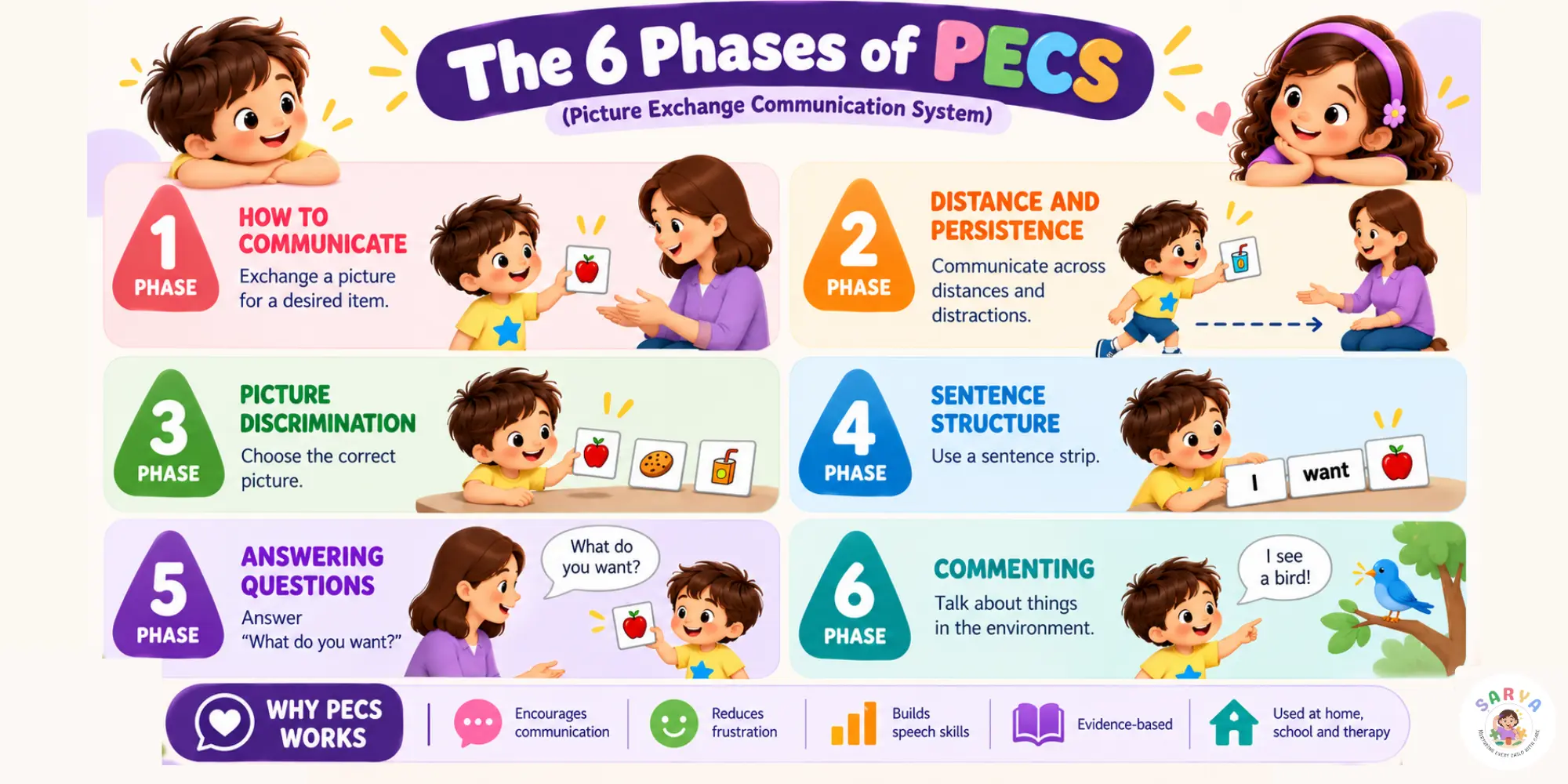
Here is the parent-friendly version.
Phase 1: How to Communicate
In the first phase, the child learns the basic exchange: give a picture to another person to get something they want.
Example: the child gives a picture of bubbles, and the adult immediately gives bubbles.
The goal is to teach: “When I give this picture to someone, they understand me.”
Phase 2: Distance and Persistence
Once the child understands the exchange, they learn to use it with different people, in different places, and across a little distance.
This matters because communication should not work only at one table with one therapist. The child should learn to find the picture, approach the person, and keep trying to communicate.
Phase 3: Picture Discrimination
In this phase, the child learns to choose between two or more pictures.
Example: the child chooses between juice and ball. This helps the child become more specific and intentional.
Phase 4: Sentence Structure
The child begins building simple picture sentences, often using a sentence strip.
Example: “I want” plus “juice.”
This is where PECS starts moving from single requests toward more structured communication.
Phase 5: Answering Questions
The child learns to answer questions such as, “What do you want?”
This is important because communication is not only spontaneous requesting. Children also need to respond when someone asks them something.
Phase 6: Commenting
In later phases, the child learns to comment using phrases such as “I see,” “I hear,” or “It is.”
This helps communication move beyond requesting food or toys. The child begins sharing attention, observations, and experiences.
PECS vs Picture Cards vs Picture Schedule: What Is the Difference?
This is one of the biggest parent confusions. PECS, picture cards, and picture schedules may all use pictures, but they do different jobs.
The simplest way to understand it is this: PECS helps a child say something. A picture schedule helps a child understand what happens next.
PECS Helps a Child Communicate
In PECS, the child exchanges a picture with a communication partner. The picture is used to send a message.
Example: the child gives a picture of a biscuit to request a biscuit.
This is communication because the child is intentionally sending a message to another person.
A Picture Schedule Helps a Child Understand a Routine
A picture schedule shows sequence. It helps a child understand what is happening now, what comes next, and when something is finished.
Example: brush teeth, wear shoes, pack bag, go to school.
For more detail, link readers to Sarya’s Visual Schedule vs. Picture Schedule and Visual Schedule for Autism. These support routine understanding, while PECS supports communication.
Sarya Supports Visual Routines, Not PECS Replacement
Sarya is not a PECS therapy replacement. It is a visual routine and schedule support tool that helps children follow daily routines using visual cards, custom photos, voice prompts, rewards, and progress tracking.
That distinction matters. If your child needs a communication system to request, answer, or comment, work with a speech-language professional. If your child needs help with daily routines, transitions, ADL skills, or visual structure, Sarya’s autism app can support home practice.
PECS vs AAC: Are They the Same?
PECS is one type of AAC, but AAC is a much bigger category.
ASHA defines AAC as clinical support that supplements or compensates for speech-language impairments. AAC can include manual signs, gestures, objects, line drawings, communication boards, letter boards, and speech-generating devices.
Low-Tech AAC vs High-Tech AAC
PECS is usually considered a low-tech or light-tech AAC system because it uses pictures, a communication book, and sentence strips.
Other AAC options may include:
- Gestures
- Sign language
- Communication boards
- Picture books
- Speech-generating devices
- Tablet-based AAC apps
- Text-to-speech tools
ASHA also notes that AAC systems should be flexible and individualized, and a person may use multiple communication modes depending on context, audience, and communication intent.
Does a Child Need to Prove Readiness Before AAC?
Parents are sometimes told to “wait for speech.” But if a child is frustrated and cannot communicate basic needs, waiting without support can make daily life harder.
A speech-language assessment can help decide whether PECS, another AAC system, speech therapy, or a combination is appropriate. The goal is not to choose pictures over speech. The goal is to give the child a communication path now.
Will PECS Stop My Child From Talking?
This is one of the most common parent worries. The short answer is: PECS is not designed to stop speech. It is designed to build functional communication.
Pyramid states that the primary goal of PECS is functional communication, and that some learners using PECS also develop speech, while others may transition to a speech-generating device.
Communication Comes First
Speech is important, but communication is bigger than speech.
A child needs a way to express:
- I want this.
- I do not want this.
- Help me.
- I am finished.
- I see something.
- I feel something.
- I need a break.
When a child gets a reliable way to communicate, frustration may reduce because the child is no longer trapped without a message.
Why Professional Guidance Matters
PECS uses specific prompting, reinforcement, error correction, picture selection, and phase progression. If taught incorrectly, a child may become dependent on prompts or may only use pictures in one setting.
That is why parents should work with a speech therapist, PECS-trained therapist, AAC specialist, or autism communication team. Aaryavart offers PECS Communication, Speech Therapy, and Autism Therapy support for families who need assessment-led guidance.
What Materials Are Used in PECS?
PECS materials are simple, but how they are used matters. The focus should be meaningful communication, not just collecting many cards.
A therapist will usually select pictures based on what motivates the child and what the child needs to communicate in daily life.
PECS Cards
PECS cards may show:
- Food
- Toys
- Activities
- People
- Places
- Actions
- Feelings
- Breaks
- Help
- Daily needs
In the beginning, pictures often represent highly preferred items because the child needs a strong reason to communicate.
Communication Book or Folder
A PECS communication book stores the pictures. The child learns to remove a picture and give it to the communication partner.
Pyramid describes Phase 3 as the point where pictures are placed in a PECS communication book, which is usually a binder with fastener strips where pictures are stored and removed for communication.
Sentence Strip
In later phases, the child may use a sentence strip.
Example: “I want” plus “juice.”
The sentence strip helps the child move from single-picture requests to more structured messages.
Common Mistakes Parents Should Avoid
PECS can be powerful, but only when used correctly and consistently. Many families struggle because they receive picture cards without a clear teaching plan.
Avoid these mistakes:
- Using random pictures the child does not understand
- Making PECS only about snacks
- Using PECS only in therapy, not at home or school
- Prompting too much
- Confusing PECS with a routine chart
- Treating PECS as a replacement for speech therapy
- Expecting instant speech
- Skipping assessment when communication needs are complex
- Not training family members or school staff
Aaryavart’s PECS page also emphasizes family and school training, because communication that works only in one room does not solve the real-life problem.
When Should Parents Consider PECS or Speech Therapy?
Parents should consider a communication assessment when a child is not able to express daily needs clearly. You do not need to wait until frustration becomes severe.
PECS, AAC, and speech therapy planning should be individualized to the child’s communication level, understanding, motor abilities, sensory needs, and family environment.
Signs Your Child May Need Communication Support
Speak with a professional if your child:
- Is non-verbal or minimally verbal
- Uses very few functional words
- Pulls adults instead of asking
- Cries or melts down because they are not understood
- Cannot request food, toys, help, or breaks
- Has speech delay with limited functional communication
- Uses words but not to request, answer, or interact
- Has autism-related communication concerns
- May need AAC or PECS assessment
Aaryavart’s Speech Therapy page includes support for speech delay, language development, autism-related communication concerns, and parent-guided home practice.
Where to Get Help
For therapy-led support, families can explore:
- PECS Communication for picture exchange and AAC support
- Speech Therapy for speech delay, language development, and functional communication
- Autism Therapy for autism communication, behaviour, sensory, learning, and daily living goals
- Autism Treatment for multidisciplinary support
Aaryavart’s autism therapy page describes support through assessment, ABA-based intervention, speech therapy, occupational therapy, sensory therapy, parent training, early intervention, and autism therapy at home.
How Sarya Can Support Communication-Friendly Routines at Home
Sarya should be used honestly in this topic. It is not a PECS replacement and should not be promoted as a speech therapy substitute. Its strength is helping children understand and follow visual routines at home, school, and therapy.
For many children, communication and routine support work together. A child may use PECS or AAC to request help, while Sarya supports the routine steps around brushing, dressing, mealtime, school prep, and bedtime.
How Sarya Helps Alongside Therapy
Sarya can support families by helping children:
- Follow daily routines with visual cards
- Understand what happens now and next
- Practice ADL steps at home
- Use familiar pictures and custom photos
- Hear parent-recorded voice prompts
- Build consistency across caregivers
- Track routine completion and progress
Sarya’s autism app page describes 500+ culturally authentic visual cards, voice guidance, predictable daily routines, and custom routine steps for activities such as brushing teeth, getting dressed, and packing a bag.
You can also link to Sarya’s features page, Visual Schedule for Autism, and Visual Schedule vs. Picture Schedule for parents who need routine support, not PECS implementation.
When to Use Sarya and When to Use PECS
Use this simple parent test:
- If the picture helps your child say something to someone, it may be PECS or AAC.
- If the picture helps your child know what to do next, it is a visual schedule or routine support.
Some children may benefit from both. A speech therapist can guide PECS or AAC, while Sarya can support daily routine practice.
Final Takeaway
PECS, or the Picture Exchange Communication System, is a structured way to help a child communicate using pictures. It is most often discussed for autistic, non-verbal, or minimally verbal children, but it should be chosen and taught with professional guidance.
PECS is not the same as a picture schedule. PECS helps a child communicate. A picture schedule helps a child understand routines.
If your child struggles to express needs, consider a speech-language or PECS communication assessment through Aaryavart PECS Communication or Speech Therapy. If your child needs help following daily routines, transitions, or self-care steps, Sarya can support visual structure at home.
The goal is simple: give your child a way to be understood, while continuing to build communication, confidence, and independence.
What is PECS FAQs
What is PECS in autism?
PECS is the Picture Exchange Communication System. It is a structured AAC method where an autistic child learns to give a picture to another person to communicate a request, choice, answer, or comment.
What does PECS stand for?
PECS stands for Picture Exchange Communication System.
Is PECS the same as AAC?
PECS is one form of AAC. AAC is the broader category that includes gestures, signs, objects, picture boards, communication books, speech-generating devices, and AAC apps.
Is PECS the same as a picture schedule?
No. PECS helps a child communicate with another person by exchanging a picture. A picture schedule helps a child understand a routine or sequence of activities.
Who should use PECS?
PECS may help children who are non-verbal, minimally verbal, or unable to communicate basic needs clearly. It is commonly used with autistic children, but professional assessment is important.
What are the six phases of PECS?
The six PECS phases are: how to communicate, distance and persistence, picture discrimination, sentence structure, responsive requesting, and commenting
Will PECS stop my child from talking?
PECS is not designed to stop speech. Its goal is functional communication. Some learners using PECS also develop speech, and others may transition to speech-generating devices.
Can PECS help a non-verbal child communicate?
Yes, PECS may help a non-verbal or minimally verbal child communicate needs, choices, and later more complex messages. It should be taught with trained guidance.
Can parents teach PECS at home?
Parents can support PECS at home, but they should ideally learn from a speech therapist, PECS-trained professional, or AAC specialist so the system is taught correctly and consistently.
Do I need a speech therapist for PECS?
A speech therapist or trained communication professional is strongly recommended, especially if your child has autism, speech delay, apraxia, complex communication needs, or limited understanding of pictures.
What is the difference between PECS cards and visual schedule cards?
PECS cards are exchanged with a person to communicate. Visual schedule cards show a routine, such as brushing, dressing, school, lunch, and bedtime.
Can Sarya be used for PECS?
Sarya should not be used as a replacement for PECS therapy. Sarya supports visual routines, schedules, ADL skills, voice-guided prompts, and daily practice. PECS communication should be guided by trained professionals.
When should I consider PECS communication support?
Consider PECS or AAC support if your child cannot request needs, has very limited speech, gets frustrated because they are not understood, or needs a clearer way to communicate across home, school, and therapy.
Is PECS only for requesting items?
No. PECS begins with requesting, but later phases can include choosing between pictures, building sentences, answering questions, and commenting.
Archana Pandey
Sarya Team Member