Listen to this Article
If you are searching for a visual schedule vs picture schedule, the short answer is this: they are closely related, but not always exactly the same.
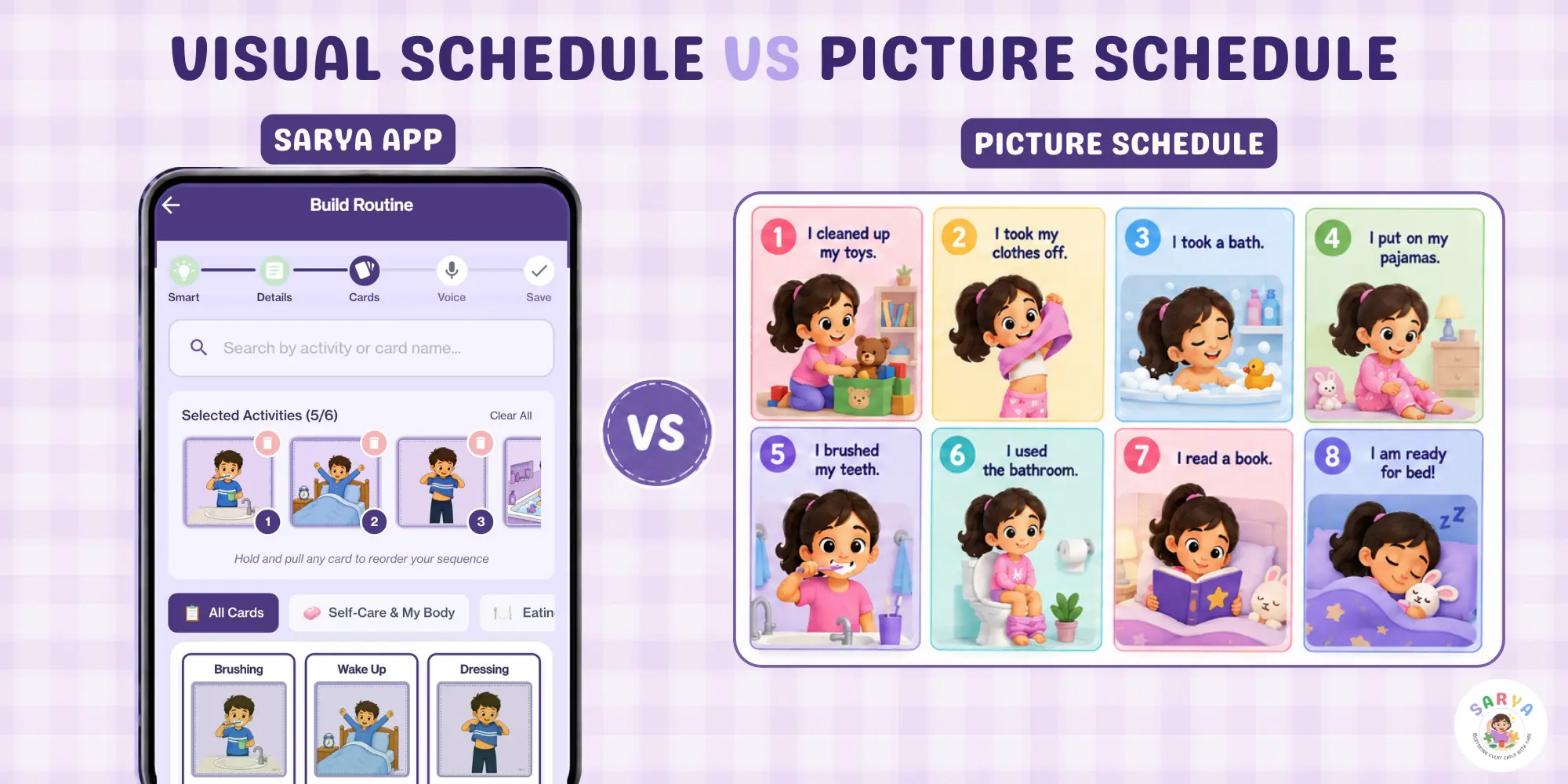
A picture schedule is usually a type of visual schedule that uses pictures, photos, icons, or symbols to show a child what is happening now and what comes next. A visual schedule is the broader term. It may include pictures, written words, objects, timers, checklists, videos, or app-based prompts.
For parents of autistic, ADHD, or neurodiverse children, the real question is not "which term is correct?" It is "which support will help my child understand routines, reduce stress, and become more independent?"
That is where the difference matters.
According to the CDC, about 1 in 31 children aged 8 years was identified with autism spectrum disorder in the latest ADDM Network data from 2022. The growing need for practical home and therapy tools makes clear, child-friendly routine support more important than ever.
Visual Schedule vs. Picture Schedule: The Simple Difference
Most parents hear both terms from therapists, teachers, and online resources. The overlap can be confusing, but the distinction is simple once you look at how each tool is used.
A visual schedule is any schedule your child can see. A picture schedule is a visual schedule that mainly uses pictures.
| Term | What It Means | Best For |
|---|---|---|
| Visual schedule | A routine shown through pictures, words, symbols, objects, timers, or an app | Children who need predictable structure |
| Picture schedule | A routine shown mainly through picture cards, photos, or icons | Young children, non-readers, visual learners |
| First-then board | A simple two-step visual schedule | Difficult transitions or quick cooperation |
| Visual timetable | A day or session shown visually | School, therapy, and full-day planning |
| Visual schedule app | A digital routine builder with cards, prompts, rewards, or tracking | Families who need flexible routines across home, school, and therapy |
So, if your child uses a morning chart with brushing teeth, getting dressed, breakfast, and school bag pictures, that is both a picture schedule and a visual schedule.
What is a Visual Schedule?
A visual schedule shows a routine in a form your child can look at, understand, and return to without relying only on spoken instructions.
For autistic children, this can be powerful because spoken instructions disappear quickly. A visual cue stays available. The child can check it again, move to the next step, and slowly build independence.
Common examples include:
- Morning routine chart
- Bedtime routine chart
- First-then board
- Classroom visual timetable
- Therapy session schedule
- Toilet training sequence
- Bathing, dressing, brushing, or mealtime routine
- App-based routine with visual cards and voice prompts
The CDC describes TEACCH as an educational approach based on consistency and visual learning, where daily routines may be written or drawn and placed in clear sight.
Why the Format Matters
The format matters because every child processes information differently. Some children respond best to real photos. Some understand simple icons. Some need written words with pictures. Some do better when the schedule speaks the step aloud.
That is why a good visual schedule should match the child, not force the child to match the tool.
What is a Picture Schedule?
A picture schedule is a routine made with picture cards, photos, symbols, or icons. It is often used for children who do not read yet, have speech delay, use limited spoken language, or struggle to follow multi-step verbal directions.
A picture schedule may show:
- "Wake up"
- "Brush teeth"
- "Use toilet"
- "Get dressed"
- "Eat breakfast"
- "Pack bag"
- "Go to school"
For many children, these pictures reduce the invisible mental work of remembering what comes next.
When Picture Schedules Work Best
Picture schedules work best when the images are easy for the child to recognize. A photo of the child's own toothbrush may work better than a generic toothbrush icon. A picture of familiar clothes, food, bathroom setup, or school bag may make the routine feel more real.
This is especially important for families whose daily routines do not look like generic Western picture cards. A schedule only helps when the child understands what the picture represents.
Are Visual Schedules and Picture Schedules Used for the Same Purpose?
Yes, most of the time they are used for the same broad purpose: to make routines visible, predictable, and easier to follow.
They can help children understand:
- What is happening now
- What comes next
- When a preferred activity will happen
- When a task is finished
- What steps are needed to complete a routine
- How to move from one activity to another
Visual supports are recognized as one of the evidence-based practices for autistic children and young people in the NCAEP review, which synthesized nearly 1,000 autism intervention studies and identified 28 focused evidence-based practices.
The Main Difference Is Scope
A picture schedule is more specific. It uses pictures.
A visual schedule is broader. It may use pictures, written words, timers, objects, videos, or app-based supports.
So the better question is not "visual schedule or picture schedule?" It is "what kind of visual schedule will my child actually understand and use?"
Which One Is Better for an Autistic Child?
For an autistic child, the better choice is the one that matches the child's developmental level, communication style, and daily routine.
Some children need real photographs. Some do well with icons. Some need a first-then board before they are ready for a full routine chart. Older children may prefer written checklists, visual timers, or app-based schedules.
The National Autistic Society notes that autistic people may communicate in many ways, including writing, gestures, AAC, picture-based systems, and high-tech communication devices. It also emphasizes that support should be adapted to the individual person's needs.
A Good Rule for Parents
Start with the simplest visual support that works.
If your child is overwhelmed by a full-day schedule, begin with two steps:
- First: brush teeth
- Then: breakfast
Once your child understands that, you can build a short morning routine. Later, you can add bedtime, school, therapy, and ADL skill routines.
Picture Schedule, PECS, and AAC: Don't Mix Them Up
Parents often confuse picture schedules with PECS or AAC because all three may use pictures. They are related, but they are not the same.
A picture schedule helps a child understand routines.
PECS, or Picture Exchange Communication System, helps a child communicate by exchanging pictures to request, choose, answer, or express something.
AAC, or augmentative and alternative communication, includes communication methods that support or replace speech, such as picture-based systems or electronic communication devices.
If your child speaks few or no words, a picture schedule can help with routine understanding, but it may not be enough for communication. In that case, professional guidance through PECS communication support or speech therapy may be helpful.
The Simple Parent Test
Ask yourself: "Is this picture helping my child know what to do, or helping my child say something?"
If it helps the child know what comes next, it is a schedule.
If it helps the child communicate a need, choice, or message, it may be PECS or AAC.
Printable Picture Schedule vs. Visual Schedule App
A printable picture schedule is a good starting point. It is low-cost, simple, and easy to put on a wall, fridge, desk, or therapy table.
But many families outgrow printable charts because routines change. Cards get lost. Parents need to recreate charts for school, therapy, grandparents, or travel.
That is where a visual schedule app can help.
A good visual schedule app for autism can offer:
- Editable routines
- Picture cards
- Custom photos
- Voice prompts
- Rewards
- Progress tracking
- Multi-routine support
- Home, school, and therapy consistency
Some competitor tools focus on paid apps, hardware-first systems, or broad productivity planning. For example, Sarya is listed as a paid visual support app on the App Store, while Goally sells a dedicated daily skills system with visual schedules and rewards.
Why Flexibility Matters
A routine tool should not create more work for parents. If your child's morning changes, the schedule should be easy to change. If your child responds better to a familiar voice, the routine should support that. If your family uses culturally specific clothing, food, or home routines, the visuals should reflect real life.
That is the gap Sarya is built to solve.
Why Sarya Is Built for Real Family Routines
Sarya is a visual routine app for autistic, ADHD, and neurodiverse children. It helps families build daily routines using visual cards, voice-guided prompts, and rewards, so children can follow steps with more confidence.
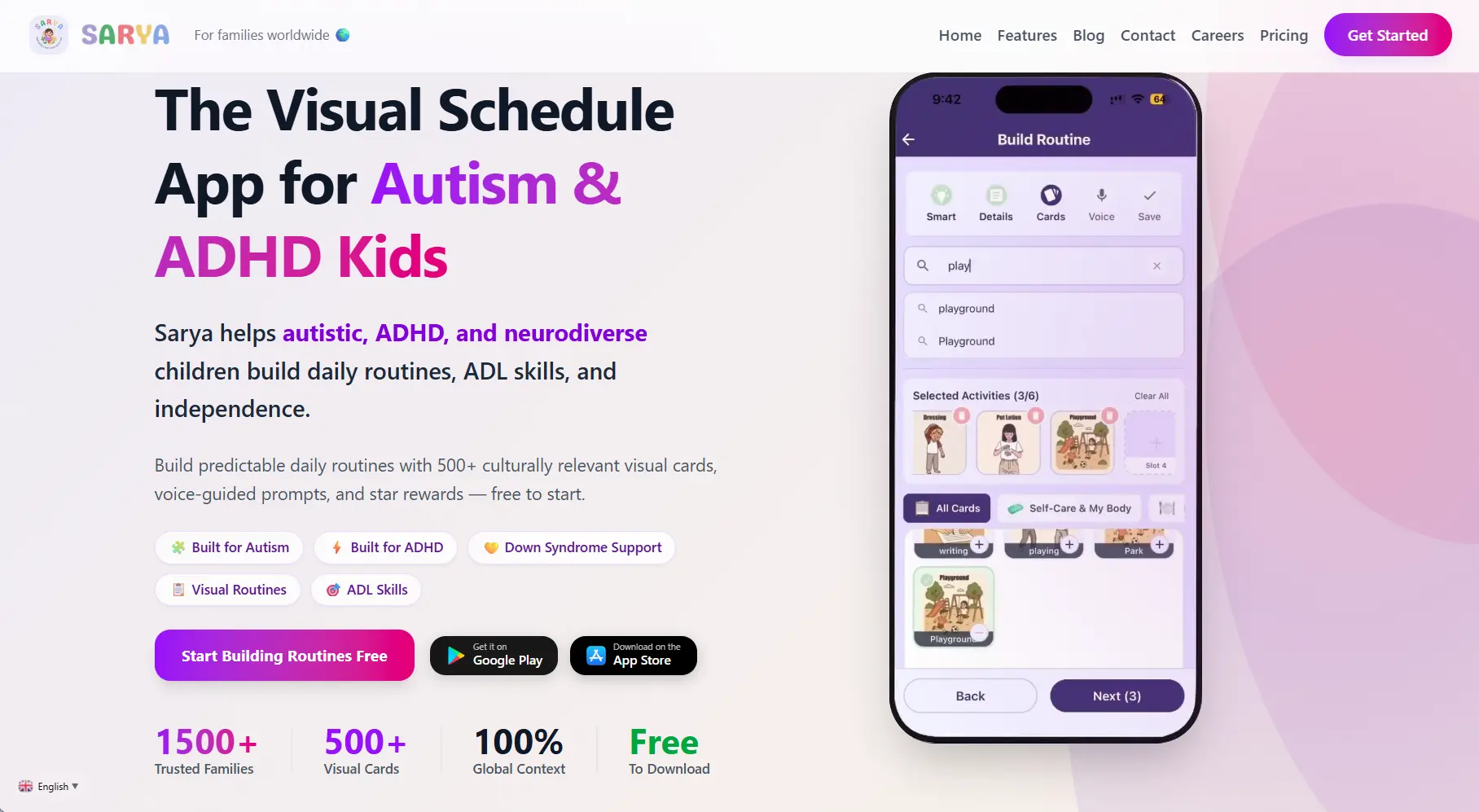
Sarya supports:
- 500+ culturally relevant visual cards
- Morning, afternoon, evening, and bedtime routines
- Parent voice recording for routine steps
- Star rewards and progress tracking
- ADL skill building for brushing, dressing, toileting, meals, and self-care
- Autism, ADHD, and Down syndrome routine support
The Sarya homepage describes the app as a visual schedule app for autism and ADHD kids, with 500+ visual cards, voice-guided prompts, and star rewards.
How Sarya Is Different
Many routine tools show generic icons. Sarya focuses on real family context.
That matters because children learn faster when the schedule reflects what they already know. A child who wears a kurta, eats from a familiar plate, takes a bucket bath, or packs a specific school bag should see routines that match that world.
You can also read Sarya's detailed guide on visual schedule for autism for a step-by-step routine-building approach.
When Should Parents Seek Professional Guidance?
A visual schedule or picture schedule can help with daily structure, but it is not a replacement for assessment, therapy, or individualized clinical support.
Consider professional guidance if your child:
- Has frequent meltdowns during transitions
- Struggles with speech or functional communication
- Has severe sensory distress
- Finds feeding, dressing, toileting, or bathing very difficult
- Shows self-injury, aggression, or unsafe behaviors
- Cannot follow even simple routines after consistent support
- Needs help across home, school, and therapy settings
WHO states that timely access to evidence-based psychosocial interventions can improve communication and social interaction for autistic children, and that support should be based on individual needs and preferences.
For therapy support, families can explore:
Aaryavart describes its autism therapy services as assessment-led support across communication, behavior, sensory needs, learning readiness, social skills, and daily living development.
Use the App and Therapy Together
The best routine support often happens when home tools and professional guidance work together. A therapist may help identify the right goals, while Sarya helps parents practice those goals every day through visual routines.
That is how progress becomes part of normal life, not only something that happens inside a therapy room.
Final Answer: Is There a Difference?
Yes, but it is a small and useful difference.
A picture schedule is a type of visual schedule that uses pictures, photos, icons, or symbols. A visual schedule is the broader category and may include pictures, words, timers, objects, videos, or app-based prompts.
For most parents, the exact label matters less than the result. The right schedule should help your child understand routines, reduce transition stress, and build independence.
If you want to start simply, begin with a 2-step first-then board. If you want a flexible tool that grows with your child, try Sarya and build your child's first visual routine free.
Visual Schedule vs Picture schedule for Autism FAQs
Is a picture schedule the same as a visual schedule?
A picture schedule is usually a type of visual schedule. A visual schedule can use pictures, words, objects, timers, or digital prompts, while a picture schedule mainly uses photos, icons, or picture cards.
What is the best picture schedule for autism?
The best picture schedule for autism is one your child understands and can use consistently. Start with familiar images, short routines, and clear steps. For many children, real photos work better than abstract symbols.
Are visual schedules evidence-based?
Yes. Visual supports are included among evidence-based practices identified for autistic children and young people in the NCAEP review of autism intervention research.
Can a visual schedule reduce meltdowns?
A visual schedule may reduce transition-related distress by showing what is happening now and what comes next. It will not remove every challenge, but it can reduce uncertainty, which is often a major trigger during routines.
Is PECS the same as a picture schedule?
No. PECS is a communication system where a child uses pictures to communicate. A picture schedule is used to show a routine or sequence of activities. Some children may benefit from both.
Should I use photos or icons?
Use whichever your child understands faster. Many young children and children with developmental delays begin with real photos. Icons can work later if the child can connect the symbol with the real activity.
What age should I start a visual schedule?
Many families start around toddler or preschool age, especially when routines like brushing, dressing, toileting, meals, or bedtime become difficult. Older children and teens can also benefit from visual schedules adapted to their level.
Is an app better than a printable picture schedule?
An app is better when routines change often, when you need voice prompts, when multiple caregivers are involved, or when you want progress tracking. A printable schedule can still be useful for simple, fixed routines.
Can visual schedules help children with ADHD too?
Yes. Children with ADHD often struggle with working memory, time awareness, and task switching. A visual routine can make steps easier to see, follow, and complete.
How do I get my child to actually follow the schedule?
Start small. Use 2 to 4 steps, review the schedule before the routine begins, use the same words each time, celebrate completion, and avoid changing pictures too often. If the routine is still hard, get guidance from a therapist and use a tool like Sarya to keep daily practice consistent.
Archana Pandey
Sarya Team Member