Listen to this Article
Many parents do not search for a daily schedule because they want a perfect day. They search because mornings feel rushed, transitions become emotional, meals take too long, screen time becomes a battle, and bedtime feels never-ending.
For many autistic children, a predictable routine can make the day feel safer and easier to understand. The CDC explains that structured educational approaches for autism often use consistency and visual learning, including daily routines that are written or drawn and placed in clear sight.
A daily schedule for autistic child is not about controlling every minute. It is about helping your child understand what is happening now, what comes next, and what is expected.
Sarya helps parents build visual daily routines with picture cards, familiar voice prompts, star rewards, and progress tracking, so routines become easier to follow at home.
What is a Daily Schedule for an Autistic Child?
A daily schedule is more than a timetable. For an autistic child, it works like a visual communication tool that makes the day easier to predict.
A simple daily schedule shows the child the main activities of the day in order. It can use photos, icons, drawings, written words, voice prompts, or a mix of these.
A basic autism daily routine may include:
- Wake up
- Toilet
- Brush teeth
- Bath
- Get dressed
- Breakfast
- School
- Therapy
- Play
- Dinner
- Bedtime
Younger children may need picture-based schedules. Older children may use written checklists, visual routine apps, timers, or a combination of tools.
Why a Visual Routine Works Better Than Repeating Instructions
Many autistic children find spoken instructions hard to process, especially when they are tired, anxious, distracted, or overloaded. Verbal instructions disappear quickly, but a visual schedule stays visible.
Autism Speaks explains that visual supports can help children and adults with autism communicate, and may include pictures, objects, written words, or lists.
This is why a parent saying “brush, wear clothes, eat breakfast, pack your bag” may not work as well as showing the same steps visually.
Why Autistic Children Often Need Predictable Routines
Predictability can reduce confusion. When a child knows what is coming next, transitions often become easier and daily life feels less sudden.
The National Autistic Society explains that autistic people may prefer set routines, knowing what will happen in advance, and clear rules. It also notes that support may be needed when routines become so rigid that changes cause significant distress.
Routine Reduces Uncertainty
Many difficult moments happen during transitions, not during the activity itself. A child may enjoy playing but struggle when play suddenly ends. A child may like bathing but resist walking from the bedroom to the bathroom.
A routine makes the change visible before it happens.
Example: “First play, then bath.”
This short structure is easier than giving a long explanation during an emotional moment.
Routine Builds Independence
A visual routine helps the child begin tasks without waiting for repeated verbal prompting.
Instead of asking again and again, “Did you brush? Did you wear socks? Did you pack your bag?”, the parent can guide the child back to the schedule.
Over time, the goal is not just compliance. The goal is independence.
Routine Helps Parents Understand Patterns
A daily routine also helps parents see where the day is breaking down.
Maybe the child struggles after school, not in the morning. Maybe bedtime becomes difficult only after late screen time. Maybe therapy transition is hard because there is no rest break before it.
A schedule turns daily chaos into visible patterns.
How to Create a Daily Schedule for Autistic Child
Start small. A daily schedule should be easy enough for your child to understand and easy enough for you to actually use.
Many parents make the first schedule too long. Then the child ignores it, and the parent feels it failed. The better approach is to begin with one routine and build gradually.
Step 1: Start With One Part of the Day
Do not build a full-day schedule on day one. Choose the part of the day that creates the most stress.
Good starting points:
- Morning routine
- Bedtime routine
- After-school routine
- Brushing routine
- Mealtime routine
- Therapy home-practice routine
For example, if mornings are difficult, start only with the morning routine.
Step 2: Use 4 to 6 Steps First
A long routine may overwhelm the child. Keep the first routine short.
Example morning routine:
- 1Wake up
- 2Toilet
- 3Brush
- 4Get dressed
- 5Breakfast
- 6School bag
Once your child understands these steps, you can add more detail.
Step 3: Use Pictures, Icons, or Real Photos
Use the format your child understands best. Some children respond to simple icons. Some understand real-life photos better. Some older children prefer written words with small pictures.
You can use:
- Photos of your child’s real toothbrush, clothes, bag, and plate
- Simple visual cards
- Written labels
- A visual schedule app
- A first-then board
- A printed routine chart
Sarya allows parents to choose from 500+ visual cards, upload their own photos, reorder steps, and record custom voice prompts for routines.
Step 4: Keep the Schedule Visible
A schedule works only when the child can see it at the right moment.
For a printed routine chart, place it near the activity area. Morning routine can be near the bed or wardrobe. Brushing routine can be near the bathroom. Mealtime routine can be near the dining area.
For an app-based routine, keep the device ready before the transition starts.
Step 5: Add a “Finished” Action
Many children need closure. A finished step tells the child, “This part is done.”
You can let the child:
- Move the card to a finished column
- Tick a box
- Tap complete in an app
- Earn a small star or visual reward
- Place the card in a finished pocket
Sarya includes star rewards and progress tracking, which can help children see completed routines and help parents notice what is improving.
Step 6: Practice the Same Routine for 7 to 10 Days
Do not keep changing the routine too quickly. Autistic children often need repetition before a schedule becomes familiar.
Use the same order, same words, and same visual cues for several days. Once the child begins to understand the routine, you can slowly add flexibility.
Sample Daily Schedule for Autistic Child
A sample routine helps parents see what a real day can look like. You do not need to copy this exactly. Use it as a base and adjust it around your child’s age, school timing, therapy, sleep, food, and sensory needs.
Morning Routine for Autistic Child
Mornings are often hard because there are many transitions in a short time. Keep the routine simple, visual, and calm.
| Time | Activity |
|---|---|
| 7:00 AM | Wake up |
| 7:10 AM | Toilet |
| 7:20 AM | Brush teeth |
| 7:30 AM | Bath |
| 7:45 AM | Get dressed |
| 8:00 AM | Breakfast |
| 8:20 AM | Pack school bag |
| 8:30 AM | Leave for school |
Tip: Avoid giving too many verbal instructions at once. Point to the next step and use short language.
Example: “Brush next.”
After-School Routine for Autistic Child
After school, many autistic children need decompression. They may look “fine” outside but feel tired, hungry, overstimulated, or emotionally full.
| Time | Activity |
|---|---|
| 3:30 PM | Come home |
| 3:40 PM | Snack |
| 4:00 PM | Rest or sensory break |
| 4:30 PM | Therapy or home activity |
| 5:15 PM | Free play |
| 6:00 PM | Homework |
| 6:30 PM | Screen time, if allowed |
| 7:00 PM | Family time |
Tip: Do not start homework the moment the child reaches home if they usually melt down after school. Add a predictable rest break first.
Bedtime Routine for Autism
Bedtime should feel boring in a good way. Too many instructions, bright screens, or sudden demands can make sleep harder.
| Time | Activity |
|---|---|
| 8:00 PM | Dinner |
| 8:30 PM | Quiet play |
| 8:45 PM | Brush teeth |
| 9:00 PM | Story or calming routine |
| 9:15 PM | Sleep |
Tip: Keep bedtime steps short and repeat them in the same order daily.
What Should Be Included in an Autism Daily Routine?
A good autism daily schedule should include more than school and therapy. It should support real life: self-care, communication, movement, play, meals, rest, and sleep.
The aim is not to make the child busy. The aim is to make the day understandable.
Self-Care and ADL Skills
ADL means Activities of Daily Living. These are everyday independence skills that children gradually learn.
Include routines for:
- Brushing teeth
- Bathing
- Dressing
- Toileting
- Eating
- Washing hands
- Packing bag
- Cleaning up toys
- Wearing shoes
Sarya supports ADL skills through visual learning, step-by-step routines, and familiar daily contexts.
Learning and Therapy Practice
Many children receive therapy goals for speech, OT, behaviour, sensory regulation, or school readiness. These goals work better when they are practiced in daily routines.
You can include:
- Speech practice
- Fine motor activity
- Sensory activity
- Matching or sorting
- Reading time
- Home program task
- Parent-child play
- Social communication practice
If your child already receives therapy, ask the therapist which 1 or 2 home activities should be included in the schedule.
For expert therapy guidance, parents can explore Aaryavart Autism Therapy, Speech Therapy, Occupational Therapy, and Parent Training. Aaryavart provides assessment-led therapy planning, online support, and centre-based care in Lucknow, Gorakhpur, and Unnao.
Sensory Breaks
Some children need movement before sitting. Some need quiet after school. Some need deep pressure, a calm corner, or reduced noise.
A sensory break is not a reward. It is regulation support.
Examples:
- Swinging
- Jumping
- Wall push-ups
- Quiet corner
- Deep pressure activity
- Breathing activity
- Walking
- Low-light rest
If sensory issues are affecting routines, explore Aaryavart Sensory Therapy.
Play and Choice Time
A routine should not remove joy. Children need choice, free play, and preferred activities.
Add small choices inside the schedule:
- “Blocks or puzzle?”
- “Red shirt or blue shirt?”
- “Story or music?”
- “Swing or ball?”
Choice gives the child some control without removing structure.
Visual Schedule, Written Schedule, or App: Which Is Better?
The best schedule is the one your child understands and your family can use consistently.
There is no single perfect format. Choose based on your child’s age, communication level, attention, reading ability, and routine needs.
Printable Visual Schedule
A printable schedule works well when you want something fixed and visible at home.
Best for:
- Toddlers
- Preschool children
- Bathroom routines
- Bedtime routine
- Classroom-style routine
- Children who do better with wall charts
Limitation: Printed schedules can be harder to edit when plans change.
Written Schedule
A written schedule works well for children who can read and understand sequence.
Best for:
- Older children
- School routines
- Homework
- Chores
- Independent self-care
- Daily checklists
Tip: Even older children may still benefit from icons, colour coding, or checkboxes.
Visual Schedule App
A visual schedule app is useful when routines change, parents need flexibility, or the child responds well to interactive steps.
Best for:
- Morning and bedtime routines
- Therapy home practice
- Travel routines
- Multiple caregivers
- Progress tracking
- Voice-guided prompts
- Children who need motivation through completion
Sarya supports visual routine building with 500+ culturally relevant cards, parent voice prompts, therapist-approved routines, star rewards, and progress tracking.
Common Mistakes Parents Make With Daily Schedules
A schedule can be very helpful, but only when it is introduced gently. If it becomes another demand, the child may resist it.
Here are mistakes to avoid.
Making the Schedule Too Long
A child who is just learning routines may not manage 15 steps. Start with fewer steps and expand slowly.
Better: “Brush, dress, breakfast, bag.”
Not: “Wake up, fold blanket, drink water, toilet, wash face, brush, rinse, towel, clothes, socks, shoes, breakfast, plate in sink, bag, bottle, bus.”
Using the Schedule Only During Meltdowns
A visual routine should be used before the difficult moment. If you show it only when the child is already crying, the child may not be ready to process it.
Use it calmly when the child is regulated.
Changing the Routine Every Day
Children need repetition to learn the schedule. If the visuals, words, and order keep changing, the routine may not become familiar.
Depending Only on Words
Some children understand spoken language but still need visual support during transitions. Use short words with pictures.
Example: “First bath, then snack.”
Removing All Flexibility
A schedule should create predictability, not fear of change. Add small planned changes once the child understands the routine.
How to Handle Changes in Routine
Changes will happen. School holidays, guests, illness, travel, therapy timing, weather, and family plans can all change the day.
The goal is not to avoid every change. The goal is to make change visible and less sudden.
Use a “Change” Card
A change card tells the child that something will be different today.
Example: “Today: no school. Home day.”
Keep it simple and visual.
Show What Stays the Same
Children often cope better when they know the whole day is not changing.
Example: “School is closed today. Breakfast, play, lunch, bath, and bedtime are the same.”
Use First-Then Language
First-then boards are simple and powerful for transitions.
Examples:
- First brush, then story.
- First therapy, then park.
- First bath, then snack.
- First homework, then screen time.
Give Advance Notice
When possible, tell the child before the change happens. Use a visual, not only a verbal warning.
Example: “After lunch, doctor visit.”
This is easier than suddenly asking the child to get ready.
Daily Schedule by Age
A daily schedule should grow with the child. A toddler’s schedule should look different from a school-age child’s routine.
Daily Schedule for Autistic Toddler
Toddlers need short, visual, repeatable routines. Focus on basic daily rhythm rather than exact clock time.
Include:
- Wake up
- Toilet or diaper change
- Brush
- Bath
- Breakfast
- Play
- Snack
- Nap
- Outdoor time
- Dinner
- Bedtime
Use real photos if the child does not understand icons yet.
Daily Schedule for School-Age Autistic Child
School-age children often need support with transitions, homework, therapy, self-care, and emotional regulation.
Include:
- Morning routine
- School routine
- After-school rest
- Snack
- Therapy or home practice
- Homework
- Play
- Screen time rules
- Dinner
- Bedtime
A visual routine app can help because school days, therapy days, and weekends may differ.
Daily Schedule for Older Autistic Children
Older children may need support for independence and executive functioning.
Include:
- Wake-up checklist
- Hygiene routine
- School preparation
- Homework planning
- Chores
- Exercise
- Hobby time
- Emotional regulation break
- Sleep routine
You can link independence goals with Aaryavart Life Skills Training when daily living skills need structured therapy support.
How Sarya Helps Parents Build Daily Routines
Sarya is designed for families who want routine support that is simple, visual, and practical.
Instead of repeating the same instruction many times, parents can create a routine the child can see, hear, complete, and repeat.
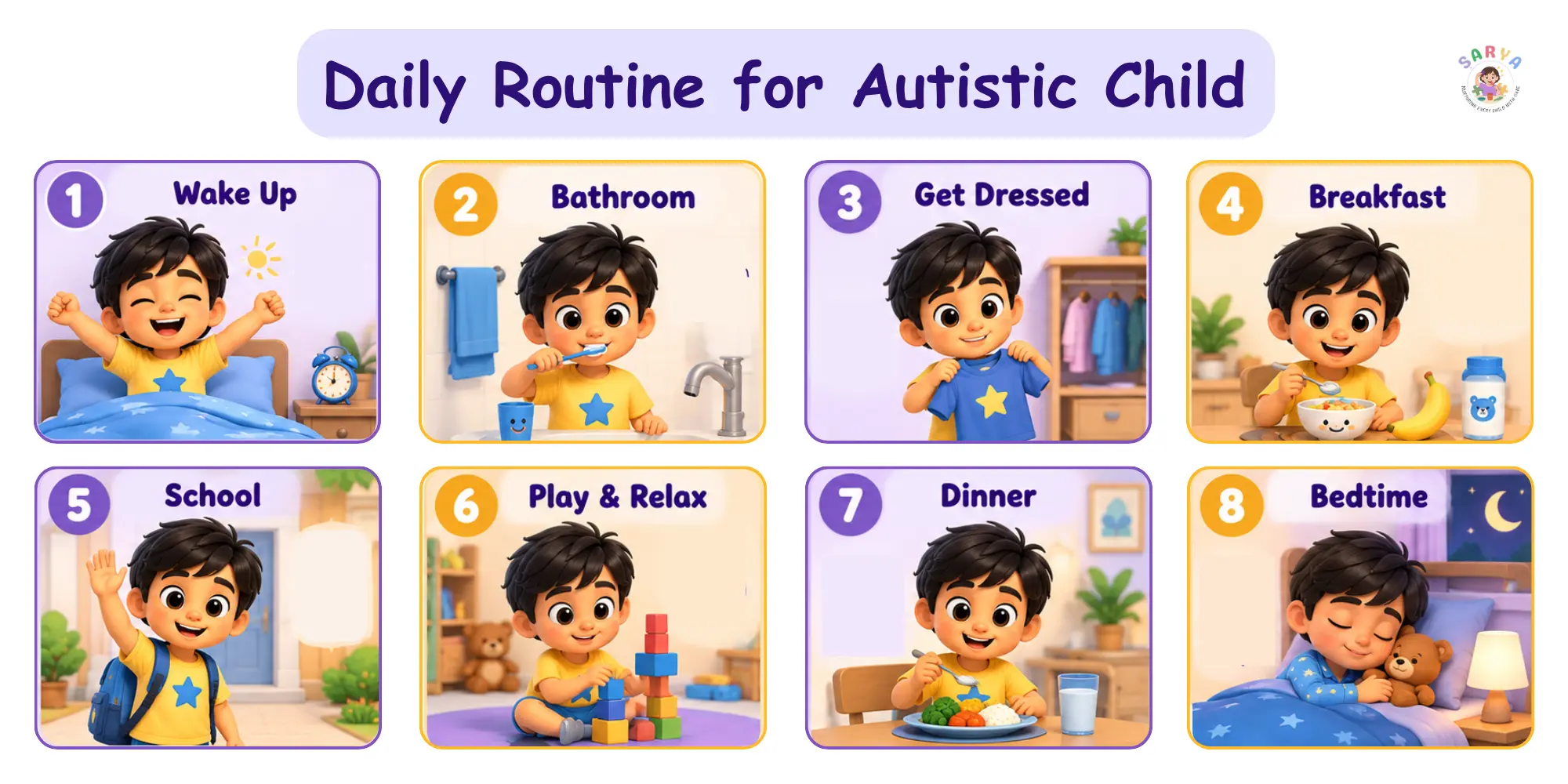
Build Routines With Visual Cards
Parents can create morning, afternoon, evening, night, self-care, school-prep, and bedtime routines. Sarya includes culturally relevant visual cards for daily life and allows parents to customize routines around the child’s actual environment.
Add Familiar Voice Prompts
Some children respond better to a parent’s voice than a generic instruction.
Sarya allows parents to record voice prompts for routine steps, so the child hears familiar guidance during transitions.
Use Star Rewards Carefully
Rewards should encourage participation, not pressure the child.
A simple star after completing a step can help some children understand progress and feel successful.
Track What Is Improving
Progress tracking helps parents see which routines are becoming easier and which still need support.
This is useful for parents, therapists, and caregivers because routine progress often shows up in small daily wins.
Start with one routine today: morning, bedtime, brushing, dressing, or school bag. Build your child’s first visual schedule with Sarya.
When a Daily Schedule Is Not Enough
A daily schedule can support many children, but it does not replace professional assessment, therapy, or medical guidance.
If routines are still very difficult, there may be deeper needs related to speech, sensory processing, attention, sleep, anxiety, motor skills, behaviour, or developmental delay.
Seek Expert Support If You Notice
- Severe meltdowns during transitions
- No response to simple routine steps
- Speech delay or limited communication
- Feeding difficulties
- Sleep problems
- Self-care delays
- Aggression or self-injury
- Sensory overload in daily routines
- Difficulty with school readiness
- Loss of previously learned skills
Aaryavart Centre provides child development assessment, autism therapy, speech therapy, occupational therapy, sensory therapy, parent training, online guidance, and centre-based support in Lucknow, Gorakhpur, and Unnao. Their assessment process includes parent discussion, child observation, developmental review, and a therapy roadmap.
Conclusion
A daily schedule for autistic child does not need to be perfect. It needs to be clear, visual, repeatable, and realistic for your family.
Start with one routine. Use pictures. Keep steps small. Practice daily. Add flexibility slowly. When your child can see what comes next, everyday life often becomes calmer for both the child and the parent.
Build your child’s first visual daily schedule with Sarya. If your child needs assessment, therapy, or parent-guided developmental support, connect with Aaryavart Centre.
Daily Schedule for Autistic Child FAQs
What is the best daily schedule for autistic child?
The best daily schedule for autistic child is simple, visual, predictable, and matched to the child’s understanding level. It should include self-care, meals, school, therapy, play, sensory breaks, and bedtime.
How do I make a daily routine for my autistic child?
Start with one part of the day, such as morning or bedtime. Use 4 to 6 visual steps, keep the schedule visible, practice daily, and add more steps only when your child understands the routine.
Do autistic children need strict routines?
Many autistic children benefit from predictable routines, but the routine should not become too rigid. The goal is predictability with gentle flexibility, so the child can slowly learn to handle small changes.
Are visual schedules good for autism?
Yes, visual schedules can help autistic children understand what is happening now and what comes next. Visual supports can improve communication, reduce confusion, and support transitions.
What should be included in an autism daily routine?
An autism daily routine may include waking up, toileting, brushing, bathing, dressing, meals, school, therapy, sensory breaks, play, homework, screen time, family time, and bedtime.
How do I handle schedule changes with an autistic child?
Use a visual “change” card, give advance notice, show what stays the same, and use first-then language. Keep your explanation short and calm.
Is a visual schedule app better than a printable schedule?
Both can work. A printable schedule is simple and visible at home. A visual schedule app like Sarya is more flexible because parents can edit routines, add voice prompts, use rewards, and track progress.
Can a daily schedule reduce meltdowns?
A daily schedule may reduce some meltdowns by making transitions and expectations clearer. If meltdowns are frequent, intense, or linked to speech, sensory, sleep, or behaviour concerns, professional assessment may be needed.
Can Sarya help with morning and bedtime routines?
Yes. Sarya helps parents create visual morning routines, bedtime routines, brushing routines, dressing routines, school-prep routines, and other daily living routines using visual cards and voice prompts.
When should I seek professional help beyond a schedule?
Seek help if your child has severe transition meltdowns, speech delay, sensory overload, feeding issues, sleep problems, self-care delays, or difficulty following even simple routines. A developmental assessment can help identify the right support.
Archana Pandey
Sarya Team Member